Malawi’s Social Cash Transfer Programme (SCTP) is no longer being run on government terms and timelines, but donor ones.
That is the conclusion of Beyond the Transaction: The Political Economy of Donor-Government Collaboration in Malawi’s Social Cash Transfer Programme, published in the second volume of the Malawi Journal of Politics and Public Affairs and launched on Thursday evening.
The paper argues that because development partners provide 95 percent of SCTP funding, they have acquired outsized leverage over how the programme is designed and delivered.
Government’s contribution has averaged just five percent since 2016/17.The World Bank provides 36 percent of funding, Germany 27 percent, the European Union (EU) 23 percent, Irish Aid seven percent and Unicef one percent for technical support.
According to the study, this imbalance allows donors to set the pace of implementation, determine targeting approaches and influence policy decisions that would ordinarily fall under government.
Researchers describe the arrangement as shifting SCTP from a nationally-owned social protection instrument to one where key decisions are negotiated with, and often approved by, funders.
Authors Professor Michael Chasukwa and Harold Kapito argue that because donors provide most of the financial resources and significant technical expertise, they have considerable leverage over funding priorities, policy choices and the pace of implementation.
The paper states: “While formal collaborative structures exist, informal power imbalances challenge programme sustainability and effective coordination.
“Although fieldwork findings show that revising the cash transfer value is a negotiated process, donors often provide the stopgap funding and, therefore, influence the direction of the process.”
Aid comes with power
The study identifies seven major issues affecting SCTP implementation, including donor dependency, power influence, patron-client relationships, coordination and competition challenges, and the absence of strategies for long-term sustainability.
It finds a pronounced power asymmetry, with donors exerting significant influence over decision-making because of their financial leverage and technical expertise.
Consequently, Malawi’s autonomy in designing and implementing social protection programmes remains constrained.
“The political economy framework applied in this study underscores that the collaboration between donors and the Government of Malawi is not merely technical or administrative, but is deeply embedded in resource-based power relations and politically negotiated settlements.
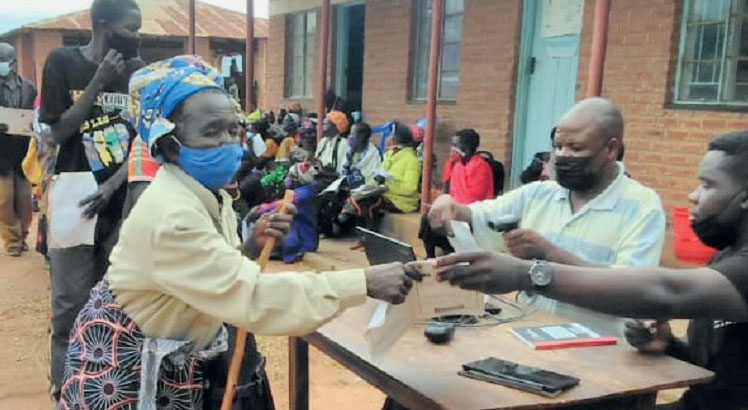
November – December cash transfers. | Bishop Witmos, Mana
“Although a cordial and among actors, these interactions are often circumscribed by the financial control that donors exercise, which effectively shapes the policy and implementation landscape of the SCTP,” the study says.
The geographical spread of donor financing further illustrates the dependency. The World Bank funds 11 districts, while the EU supports seven. Germany also supports seven districts, while Ireland funds two.
The study also reveals tensions between the Ministry of Finance, Economic Planning and Decentralisation, and the Ministry of Gender, Children and Social Welfare over programme ownership, alongside competition among donors with different priorities.
The researchers say the establishment of the Multi-Donor Trust Fund (MDTF) has intensified some of these tensions by recognising the National Local Government Finance Committee (NLGFC) as a key financial actor within the World Bank business model.
One consultant interviewed for the study said: “That’s definitely a challenge at the government kind of political level, the kind of the balance of power and who is in control.”
The study concludes that neither the Ministry of Gender nor the Ministry of Finance feels a strong sense of control and autonomy over SCTP operations.
Funding crisis
Government has cut the social protection budget for the 2026/27 financial year from K217 billion in the previous fiscal calendar to K123 billion, affecting about one million beneficiaries. Of the new allocation, government is contributing only K7 billion.
SCTP funding has fallen by 14 percent, while the Climate Smart Enhanced Public Works Programme (CSE-PWP), also known as Mtukula pa Khomo, has lost 57 percent of its financing. Urban Public Works Programme financing is down 35 percent.
In June, civil society organisations convened a national dialogue on inclusive social protection in Lilongwe, focusing on sustainable financing, human rights and a progressive legal framework.
Speaking at the meeting, poverty reduction and social protection senior deputy director in the Ministry of Finance Dalitso Kalimba said the K93 billion decline in allocation was driven by falling international donor contributions.
“The reduction in funding is expected to scale back the reach and capacity of several flagship safety net initiatives,” he said.
Applied economist Steve Kayira warned that if major donors reduce or withdraw support, government could face a sharp financing gap, forcing it to reduce beneficiary coverage, lower transfer values, delay payments, or divert scarce domestic resources from other priorities.
“This could also reverse poverty-reduction gains and increase vulnerability among poor households. The problem is particularly serious because social protection requires predictable, long-term financing rather than short-term project-based funding,” he said.
Way out
Kayira urged government to progressively increase its budgetary contribution while protecting SCTP allocations from expenditure volatility.
“This requires improving domestic revenue mobilisation, broadening the tax base, reducing inefficient and non-priority expenditure, strengthening public financial management and improving the efficiency of social protection delivery.
“Malawi should negotiate with development partners for a predictable transition framework, where donor resources increasingly support capacity-building and systems strengthening while domestic resources finance a growing share of recurrent transfers,” he said.
Kalimba said the Ministry is developing a Social Protection Legal Framework that will provide a comprehensive legal framework for social protection, strengthen institutional arrangements and promote greater consistency and sustainability in the delivery of social protection services nationwide.
Northern Region CSOs on Social Protection vice-chairperson Kinnear Mlowoka also called for increased budgetary allocations as one of the possible sustainable solutions.
On his part, Centre for Human Rights and Rehabilitation (CHRR) executive director Michael Kaiyatsa said donor support should strengthen the programme while government progressively increases its own contribution.
“The people who depend on the SCTP should not have their livelihoods determined by whether donors decide to continue funding it,” he said.
Millions remain vulnerable
United Nations data show that social safety nets reach only 27 percent of more than 20 million Malawians, despite around 71 percent of them living below the international poverty line of $2.15 (roughly K3 800) a day.
Malawi spends only 0.9 percent of its gross domestic product on social safety nets, below the regional average of two percent.
With 95 percent of SCTP financing coming from donors, Malawi is exposed not only to funding shortfalls but also to shifts in external priorities.
During the study report’s Thursday launch, Political Science Association of Malawi Secretary General Makhumbo Munthali said sound public policy and effective governance depend on evidence, critical inquiry, and informed debate, which the Journal is presenting.